Twelve-year-olds are rampaging through Sephora and demolishing the product testers. TikTok is saturated with skincare videos, and skincare influencers have emerged as a dominant trend across several platforms.
Thousands of young people are squandering money on skincare just to delay the inevitability of looking old. The hobbies of children have shifted from unicorns and rainbows to retinol and gua-shas.
This is Gen Z.
Grand View Research estimated that the global anti-aging cosmetics market is currently valued at approximately $52.44 billion, projected in 5 years to grow up to $80.61 billion.
Skincare has evolved into a pervasive part of American culture, and now Gen Z is equally consumed by this obsession. There have been multiple instances where kids raided stores like Sephora to acquire products; what is particularly astonishing is that some of these items cost hundreds of dollars.
But what’s behind the relentless drive to stay young forever?
And is it even beneficial for you?
Or is society the problem?
Look in the Mirror (or Maybe Don’t)
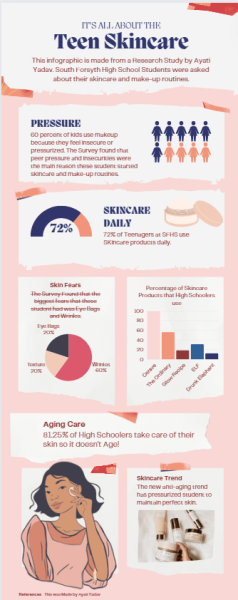
A survey of South students conducted by the Bird Feed revealed that 75% of girls at SFHS wear make-up to feel more confident, and 31.25% wear make-up because they feel “inadequate” regarding their appearance. Several girls confessed that they first embraced makeup and skincare because they felt extremely vulnerable and peer-pressured to do so.
Across the web, many assert there’s a direct link between the advent of beauty filters and the proliferation of Gen Z’s insecurities.
English teacher Erin Maley further observed, “I sometimes think that the rise of perfect glass skin and the baby-soft skin trend in beauty have somewhat of an impact on kids these days. Kids are so terrified of aging and of having non-perfect skin that sometimes it makes me think it’s more about society than the kids.”
Perhaps society and social media have imposed this obsession upon Gen Z. Growing up absorbing images of flawless faces with no imperfections inevitably conditions kids to want the same.
As senior Avani Prabhu articulates, “Seeing all these so-called ‘perfect’ people on the internet really makes everyone feel like they need to do all this unnecessary stuff to look just like them. It’s not healthy, both physically and mentally.”
Kids who are bombarded with curated faces on social media can experience a severe deterioration of their mental health, or even a condition called body dysmorphia, where the individual cannot accurately perceive their own appearance.
The Guardian reports that social media triggers children to dislike their own bodies. In a survey they conducted, three out of four children as young as 12 reported they “despise” their bodies and feel “mortified” by their appearance, a figure that escalates to eight in 10 young people aged 18 to 21.
There is truth in the possibility that Gen Z’s anti-aging obsession might in fact be galvanized by social media itself. Thousands of kids across America may be purchasing skincare in order to conceal their insecurities. This skincare frenzy appears to be fueled by anxieties that social media has manufactured and magnified.
Are we really afraid of aging, or life itself?
Thanks to a host of factors, many members of Gen Z may be missing out on the “carefree” childhoods that previous generations enjoyed.
“I think once you’re an adult, you kind of really miss those days where you didn’t really have to think about what you looked like or have any responsibilities,” Maley said. “It was so nice to just play with toys and not do anything at all. Also I think it is kind of sad that young teens are losing that certain innocence so early, and they do not have time to just simply be kids.”
Now, parents and guardians are faced with the devastating experience of watching their kids abandon their childhoods and obsess over unimportant matters like future, inevitable aging. Many adults are dismayed to find that children apply chemicals to their faces that may not even be beneficial.
A professor of psychology at Northwestern University, Renee Engeln, commented, “There is a sense in which young people have forgotten what faces look like.”
Across the board, there is a substantial amount of evidence and opinions surrounding the notion that many Gen Z individuals are trying to alter their appearance to fit beauty standards or achieve a complexion in which they view themselves as “prettier.”
The study at South Forsyth High School discovered that students are haunted by the prospect of aging. The study indicated that 50% were fearful of under-eye bags, and 61.11% were terrified of wrinkles.
Even on a local scale, it’s startling to see kids perceive wrinkles as something to dread.
“I think it’s honestly normal to be scared of aging, but to go to such extreme lengths is not good for their mental health,” Maley said. “Change is really difficult, but it’s just a part of life.”
Wrinkles, under-eye bags, and smile lines are all simply part of the natural process that all individuals undergo at some point. As we grow older, we accumulate many of these features, but that doesn’t make them inherently undesirable. TikTok has intensified the pressure to look perpetually young, but growing old isn’t “bad.”
It is inevitable.
“Just because we’re growing older doesn’t mean we’re getting uglier,” Prabhu said. “Beauty is subjective, and TikTok’s version isn’t the only one. The world needs to recognize that we are more than just some wrinkles and eye bags.”
Wrinkles, eye bags, and other signs of aging are not inherently unsightly. They are symbols of growth, laughter, joy, and the unique experiences of an individual’s life. Perhaps Gen Z’s fear of aging is not a fear of physical change, but a deeper trepidation of self-acceptance.
Whatever the answer is, you won’t find it in a bottle of retinol.
Sources:
Grand View Research. Anti-Aging Products Market Size Report, 2024.
Holtermann, Callie. “Why Does Gen Z Believe It’s ‘Aging Like Milk’?” The New York Times, March 2023.
YR Media. “Social Media, Beauty Filters and the Rise of Insecurities in Gen Z.” Esther Omolola, 2022.
The Guardian. “Children and Body Image: Social Media’s Influence,” 2023.