On Nov. 4, an election for the Georgia Public Service Commission (PSC) was held for the first time since 2020 and was open for voting across the whole state of GA.
The incumbent party (Republican) includes Jason Shaw, Fitz Johnson, Tim Echols, Lauren “Bubba” McDonald, and Tricia Pridemore. Two Democrats, Alicia Johnson and Peter Hubbard, faced off against Echols and F. Johnson to secure seats in Districts Two and Three.
What is the PSC, and what problems do people have?
“The PSC regulates the rates charged and the services provided by most intrastate, investor-owned telecommunications, natural gas and electric utilities operating in Georgia and pipeline safety regulations. The Commission does not set rates for municipally-owned electric and gas utilities or electric membership corporations (EMCs),” said the GA PSC website.
The PSC is best known for helping control the prices of citizens’ bills for gas and electricity, but it’s highly debatable whether the current party does a good job of managing those prices.
“Georgia Power bills have risen six times in recent years because of higher natural gas costs and construction projects, including two new nuclear reactors at Plant Vogtle near Augusta. A typical Georgia Power residential customer now pays more than $175 a month [for power], including taxes,” said CBS News.
At a time rife with historic economic uncertainty, many GA residents have felt this hit. People online have shared their bills before and after these price increases, and compared them to the bills of those who don’t use Georgia Power.
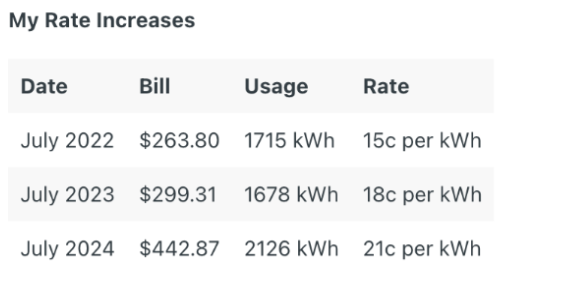
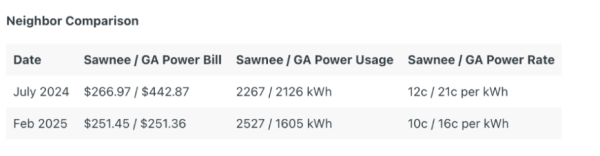
One Reddit user’s monthly bill has increased $179.07 since 2022, compared to a neighbor’s, whose bill has actually decreased while under a different power company.
Unlike your internet companies, you’re not able to choose your power provider; you’re assigned a power company based on where you live, so citizens have no choice but to pay these power bills unless they move to a different area.
A member of the Forsyth County Democrats organization, whom we’ll identify as TJ, recently explained the nuances of the PSC election to a student who attended a local chapter meeting.
TJ, a customer of Georgia Power, describes how he keeps his house 5 degrees hotter than most during the summer, using items like blackout curtains, yet he still pays more than his neighbor, who has Sawnee EMC.
“During the course of a month [my neighbor] used 2,600 kilowatts total. And they paid $300. I used 2,100 kilowatts, which is 500 less. And I paid $150 more,” said TJ.
TJ noticed something else odd about the relationship between Sawnee EMC and Georgia Power.
“The other weird thing about Sawnee EMC is that EMC actually purchases a large portion of their power from Georgia Power,” he said.
So, why would it cost so much more if it’s coming from the same source? TJ compares the discrepancy between energy companies to a car dealership.
“If I’m a car dealer and you’re a customer, you come to me, you’re going to pay a premium on the car because I need to make money on the car. But if I go to a car manufacturer and I say, hey, car manufacturer, I want to buy 70 Honda Civics from you, they’re going to cut me a deal, right?” said TJ.
At the end of the day, the power is coming from the same place, but still over 2.7 million Georgians are paying more for the same power, which is why Georgians are so frustrated with the incumbents of the GA PSC, who are meant to prevent these upcharges in power bills.
When citizens attended GA PSC meetings hoping to incite change, they noticed an emotional distance between themselves and the commissioners.
“I spoke…to the Public Service Commission, and they just sat there and just sort of looked at us like we were enemies,” said TJ.
TJ estimated that about 80% of the people at the meeting he attended were opposed to the GA PSC and its performance. He even recalled a moment when a commissioner argued with a citizen during public comments, although they were meant to be quiet.
“[The commissioner] was there on Zoom and started directly attacking one of the people making a public comment about how bad Georgia Power is,” said TJ.
Additionally, some members of the PSC weren’t elected; they were appointed and not chosen by citizens of Georgia and have stayed past their two-term limit.
“Echols represents District 2, which covers East Georgia; he was reelected to a six-year term in 2016 but hasn’t had to face voters in a general election since,” said Bolts Magazine.
It’s safe to say that many Georgians were ready for a change with this election.

Alicia Johnson and Peter Hubbard are the two Democrats who faced off against the incumbent in Districts Two and Three, and both campaigned on a platform of renewable energy and cheaper power.
These promises clearly incentivized voters, as both candidates won with approximately 60% of the vote, even in deeply red or “Republican” areas.
My first time voting and why you should vote
Myself and many others voted for the first time in this election and were inspired to see how our votes meant something and could create change.
I went on Election Day both excited and nervous to cast my vote for the first time, and I was definitely the youngest person in that room.
Everyone, especially young voters, should take action in securing their future with their vote. Voting is the perfect way of showing our government employees what we want.
Democracy isn’t a spectator sport, so get out there and vote every chance you get.