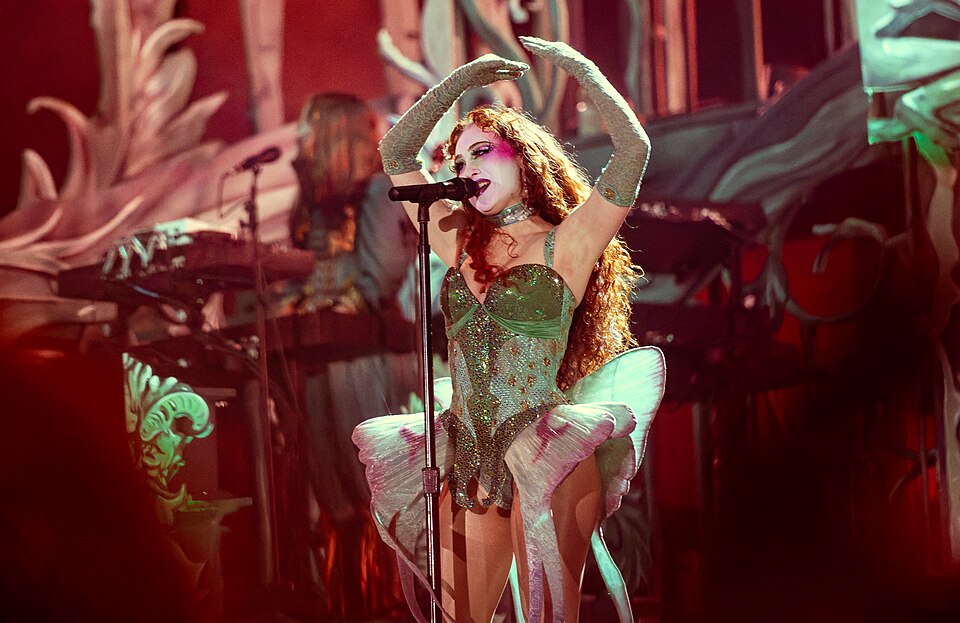
Toward the end of March, the Grammy-winning artist Chappell Roan found herself in yet another controversy surrounding the treatment of fans.
This time, the accusation came from soccer player Jorginho Frello, who claims Chappell Roan sent her security guard to “berate” his step-daughter, Ada, for smiling at Roan.
Following this bold claim, a massive wave of hate toward Roan hit social media, damaging her reputation. In an attempt to defend herself, Roan made a statement on Instagram claiming, “I didn’t even see a woman and a child.”
She was also adamant that it was not her security guard who scolded them, and even apologized for their poor interaction.
View this post on Instagram
While it was easy to embrace Frello’s claim of Chappell Roan being the mean pop-star they already saw her as, very few believed her stance of it “not” having been her security guard who chastised the child, and many left nasty, derogatory comments across all her social media platforms.
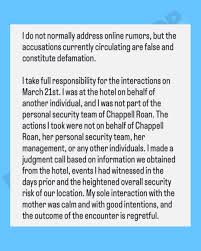
Eventually, Pascal Duvier, the alleged security guard at the hotel, came forward to address the rumors.
“The actions I took were not on behalf of Chappell Roan, her personal security team, her management, or any other individuals,” wrote Duvier on Instagram.
The post released by another man was enough to convince a few to change their minds about the popstar, but many others doubled down. Some claimed that Duvier was paid to post that in an attempt to save Roan’s image, with, of course, zero proof to back up such claims.
Finally, soccer star Frello admitted that he spoke rashly and was wrong about the situation with Chappell Roan and the security guard.
“Since then, I have become aware of new information that has changed my understanding of parts of what happened,” Frello said. “It became clear that she had no knowledge of what took place at breakfast and had not asked anyone to approach them.”
However, from my own experience, this statement was nowhere near as widely discussed compared to the original accusations across social media platforms. People were quick to post about their strong hatred for Roan, and how this proved them right on their opinion of her. Now, there seems to be an astounding lack of apologies and corrections from news-based social media accounts, who were originally highly vocal about supporting the soccer player and defaming Roan.
“What happens a lot when new celebrities come out, is that they’ll be loved for the first however many months, and then they’ll do…one small thing wrong and everyone says, ‘oh, I never liked her, I always knew she was bad.’” Senior Jessa Crossman said.
What also makes the intensity of this hate train interesting is the amount of bots that have pushed out and created hate-filled posts.
The online entertainment website NME released some astounding statistics related to Roan’s digitally-fueled hate train.
“The data analytics company GUDEA looked at 100,030 posts across social media platforms from March 20 to March 22. The posts were generated by 54,334 users, but GUDEA found that 4.2 per cent of them, or around 2,282, were ‘non-typical’ – in other words, likely bots,” NME writer Adam England reported. “These bots made up over 23 per cent, or 23,007 of the posts.”
It seems likely this was a calculated attack on Roan’s name, with similar trends seen with Taylor Swift following (false) claims of her having ties to neo-nazism— another incredibly bold accusation.
So why is it so easy for some to defame Chappell Roan and these other influential women?
The word “parasocial” has recently become the internet’s new favorite buzzword. Usually only used in the context of a fan being strangely enamored with a celebrity they don’t actually know personally. However, the phrase can also apply to someone holding an equally strange sense of hatred for a person they don’t know.
The parasocial hatred for Chappell Roan could be the result of a number of things. One, she proudly expresses herself as a queer woman in drag fashion. Two, she has never been shy about demanding healthy boundaries with over-the-top fans and paparazzi. And, three, she is very loud in her activism for many ongoing divisive issues.
Social media has amplified the intense mindset of always being morally correct. It’s not enough to just dislike someone; netizens have to justify it with the person being unmoral. It seems like whenever Roan does something that is not 100% agreeable all of the time, nameless online users are quick to tear her down as a terrible person, always being quick to say, “I could always tell something was off with her.”
Somehow, I doubt anyone was able to determine Chappell Roan’s moral alignment based on a now falsely proven claim.
Regardless, is it correct to assume someone’s character is terrible based on one mistake or mishap?
According to this absolutist mindset, wouldn’t that make everyone a bad person?
Whenever Chappell Roan fails to express herself and her opinions flawlessly, it seems the internet bands together to tear her down—which leads to another question: Why do we demand perfection from women while not even expecting mediocrity from male celebrities of similar status?
“People want women to be perfect and agreeable…and when they aren’t, it’s like the end of the world,“ said Crossman.
When Chappell Roan advocates for peace in the Middle East, she’s shot down for not wording her TikTok like an academic essay. When celebrities like Kanye West promote Nazi rhetoric, they sell out stadiums.
When Chappell Roan is a part of an alleged controversy for sending a security guard to berate an 11-year-old girl, a mayor bans her from performing in an entire city. Meanwhile celebrities like Chris Brown, who have a documented history of domestic violence, continue to be invited to events like the Grammys.
Sometimes, the comparison in the way we treat female celebrities versus male celebrities is even more obvious.
“I remember when Rachel Zegler was saying how she wanted to do the Snow White movie, but she also just needed a job, and people literally tore her apart for that,” Crossman said. “Then Jacob Elordi was asked why he did a role as Elvis, and he goes, ‘I just needed a job. I needed money.’ Everyone was praising him for a being so candid and true to himself. I felt like there was such a different standard just because [Zegler] is a woman.”
Male celebrities are constantly painted as “relatable” while women are “annoying.” Justin Bieber tells paparazzi off for harassing him? He’s “so real” and funny for that. Chappell Roan does the same? She’s rude, stuck up, and should have expected it when she chose to be a singer.
What is expected to come with fame?
I think as a population, we tend to dehumanize celebrities in a way. They’re expected to be perfect 24/7, allowing for no mistakes or else they’re inherently a bad person—creating unrealistic standards that no human being is able to meet.
We demand insight into their personal lives, wanting to know everything about them and have constant access to them, especially when they’re in public. It’s true that these things are to be expected when choosing a life of fame, although I don’t think it should be accepted, particularly when it seems these expectations mostly come at the cost of women and their wellbeing.
Ultimately, I don’t hate Chappell Roan. I don’t blame her for wanting privacy while still wanting to share her art and passions—that only makes her human. I find a woman who stands up for herself, identity, and politics in this current climate refreshing. If anything, I hope Roan never stops advocating and continues to break the norms of women being expected to be perfect and agreeable all the time.
While I wait for everyone else to catch on to the fact that Chappell Roan isn’t the devil, she will continue to go platinum on my Spotify stats.