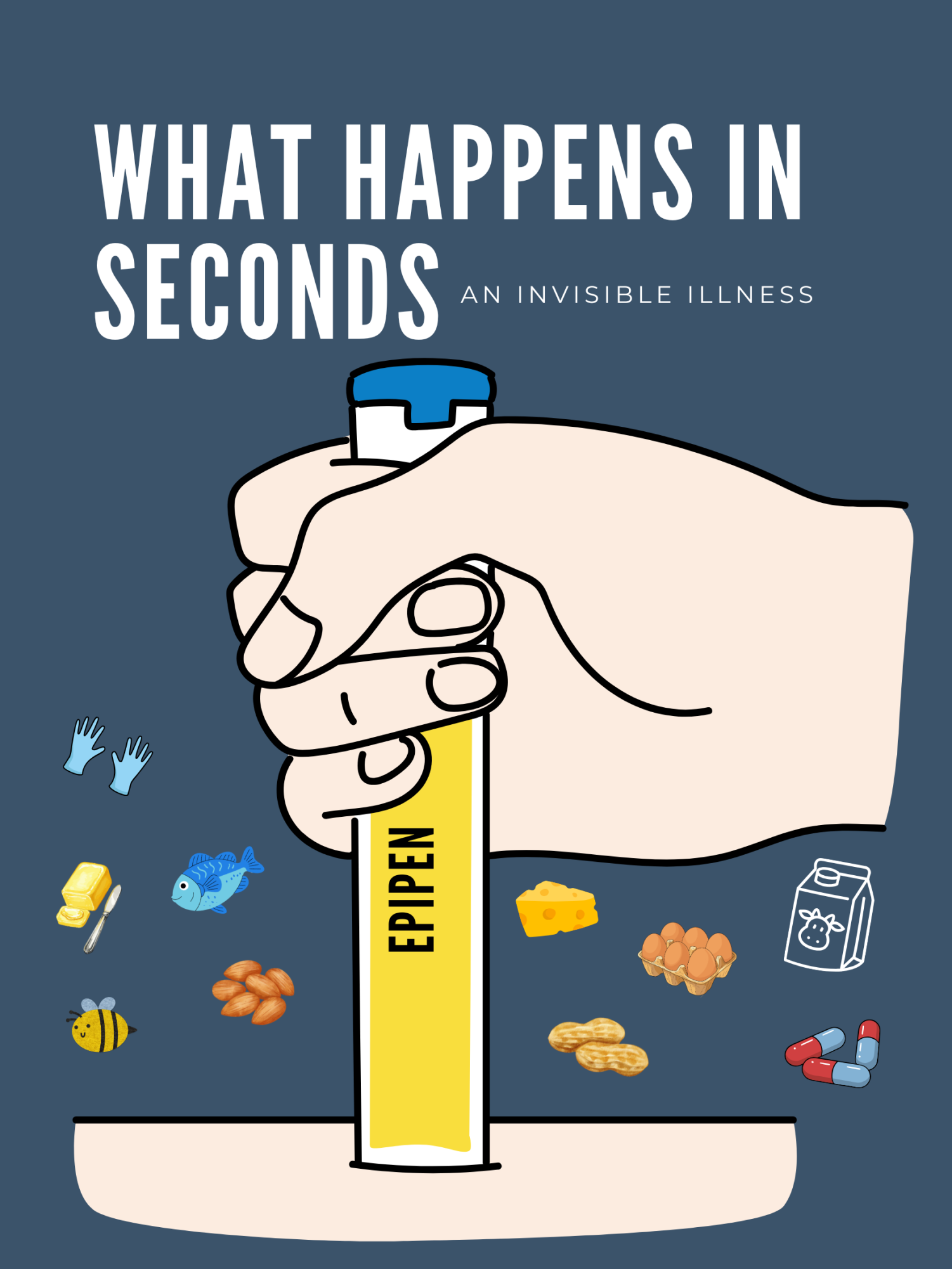
Pick up the food, check the label, and sigh in disappointment. You saw “may contain” labeled under the list of ingredients and knew the snack wasn’t worth risking your life.
The cross contamination that’s so common in factories could be the death of you one day.
But what if you missed that label and took the food off the shelf? Brought it home, opened it, and consumed it unassumingly?
Count to 10. Your killer has entered your system. It may take minutes, it may take hours, but by the time you begin to itch and hives have dotted your body, Immunoglobulin E antibodies (IgE) have already signaled the body into an immediate allergic reaction, binding to mast cells (the body’s alert system) and basophil cells in the blood stream, treating it like a parasite.
This is the beginning.
Next, the smooth muscle in your airways will have contracted and pushed fluids out of vessels, dropping blood pressure to dangerous levels. Your throat will close up, and minutes later, you will fall unconscious. Suffocation will occur within the first 10-15 minutes from the onset of reactions if you’re not injected with epinephrine.
This is the reality of those who have severe allergies, or anaphylaxis. Anaphylaxis: when the immune system classifies a typical non-harmful substance as dangerous, and the body throws itself into lockdown. For some, the trigger is peanuts; for others, fish. Most often a trigger is dairy and eggs, which are unfortunately common ingredients in most food items.
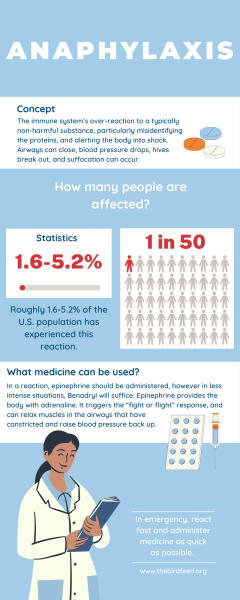
The severity of an allergic reaction depends on the person. Some only experience an itchy mouth or upset stomach, mild discomfort at most.
However, for others, anaphylaxis can be fatal.
Having this “invisible illness” is a rather complex situation. Anaphylaxis could always happen. You are free to live a normal life as long as you are constantly paying attention to what touches your skin and the ingredients in everything you eat. That is why this disease is considered “invisible”. You wouldn’t look at someone and know they could die after sharing the desk you ate peanut butter at in the class before.
So what can we do to reduce the risk for those affected? Be mindful. Start by washing your hands, especially after touching something that is a common trigger. Make sure the people around you won’t be affected by what you are eating, and if they are, save it for later. Don’t make them feel bad about it.
Most students have their own action plan in the instance of an allergic reaction, and guidelines will be followed accordingly, but if someone around you enters an emergency where they do not have an EpiPen on them, follow these steps.
“We don’t want you to leave them alone,” said South Forsyth High School’s Nurse Brown. “I want you to try to get someone to get help to come to you. So don’t leave friends by themselves. Always make sure at least one person stays with them.”
This way, if situations escalate, there is someone around to assist and monitor.
“Don’t send them on a walk to the clinic by themselves,” Brown said. “Don’t let them go anywhere by themselves because we don’t want them to accidentally fall down, stop breathing, and not have anyone know what’s going on. So I’d say for students that are looking for what they can do, just alert someone around you.”
It is important that there is someone who has been trained to respond to these scenarios around. Find someone with a walkie-talkie or any teacher. Admin and SROs (School Resource Officers) will have walkies on them that can contact emergency services and teachers can call star 99, which will contact every administrator to alert them of an emergency.
To make sure this happens as little as possible in schools, the cafeteria staff have their own procedures to prevent reactions.
“We have a list of the kids that come to our school and then they put high alerts on the cash registers,” said Patricia Martinez, a Brookwood Elementary School cafeteria staff member. “So they come through and it says that they’re allergic to peanuts. We just look at their tray to make sure they don’t have anything.”
In order to know which items to look out for, they have developed another system.
“We have little stickers to put in front of all the food,” Martinez said.
Above each item that contains an allergen, such as peanuts or sesame seeds, different stickers are used in order to identify what to look out for. This way, if a student mistakenly picks up something they shouldn’t, there is little chance of them leaving the cafeteria line with it.
But how do allergies even start? And why? To be exact, allergies are the body’s reaction to a specific protein in the substance. This is what makes milk allergies different from being lactose-intolerant. They are very much not the same, so please do not feed someone with a dairy allergy lactose free milk; it will not have the intended effect. Being lactose intolerant means your body cannot digest the sugars in dairy products.
Usually, allergies are developed because of genetic and environmental factors. Children who have parents with a specific genome or who already have allergies inherit the predisposition to allergies, but they do not directly receive one. Having a family member with allergies means a student’s risk of developing allergies is increased by 60%, which is much higher than the average person’s (0.05%-2.0%).
Unstable environmental factors can also affect a person’s development of allergies. Disruption to natural microbiomes that infants typically are exposed to can lead to a more fragile or over-reactive immune system, and exposure to pollutants can hinder immune system development.
Sometimes, allergies can fade. The immune system can change over time and adapt to tolerate what was once classified as an allergen. Sometimes, this is by introducing the individual’s system to their allergen in microdoses, carefully studied to ensure no accidents happen, or sometimes it happens on its own, and you find out at the allergist’s office after being pricked with 50 needles, each with their own common allergen on them to test reactions.
Allergies can also fade when the body produces less IgE cells, signaling less intense reactions toward the antagonistic substances. However, this does not happen for everyone, and sometimes it will only happen with one allergen, even if a person has multiple.
Unlike some other diseases, there is not one gene, chromosome, or cell that leads to someone developing anaphylactic reactions to their food of choice, so there is a lot unsaid when it comes to getting nitty gritty with the details.
What we do know for sure is the reality of these problems, and can do as much as possible to prevent them.